Paul Boddie's Free Software-related blog


Archive for the ‘English’ Category

Migrating the Mailman Wiki from Confluence to MoinMoin

Tuesday, May 12th, 2015

Having recently seen an article about the closure of a project featuring that project’s usage of proprietary tools from Atlassian – specifically JIRA and Confluence – I thought I would share my own experiences from the migration of another project’s wiki site that had been using Confluence as a collaborative publishing tool.

Quite some time ago now, a call for volunteers was posted to the FSF blog, asking for people familiar with Python to help out with a migration of the Mailman Wiki from Confluence to MoinMoin. Subsequently, Barry Warsaw followed up on the developers’ mailing list for Mailman with a similar message. Unlike the project at the start of this article, GNU Mailman was (and remains) a vibrant Free Software project, but a degree of dissatisfaction with Confluence, combined with the realisation that such a project should be using, benefiting from, and contributing to Free Software tools, meant that such a migration was seen as highly desirable, if not essential.

Up and Away

Initially, things started off rather energetically, and Bradley Dean initiated the process of fact-finding around Confluence and the Mailman project’s usage of it. But within a few months, things apparently became noticeably quieter. My own involvement probably came about through seeing the ConfluenceConverter page on the MoinMoin Wiki, looking at the development efforts, and seeing if I couldn’t nudge the project along by pitching in with notes about representing Confluence markup format features in the somewhat more conventional MoinMoin wiki syntax. Indeed, it appears that my first contribution to this work occurred as early as late May 2011, but I was more or less content to let the project participants get on with their efforts to understand how Confluence represents its data, how Confluence exposes resources on a wiki, and so on.

But after a while, it occurred to me that the volunteers probably had other things to do and that progress had largely stalled. Although there wasn’t very much code available to perform concrete migration-related tasks, Bradley had gained some solid experience with the XML format employed by exported Confluence data, and such experience when combined with my own experiences dealing with very large XML files in my day job suggested an approach that had worked rather well with such large files: performing an extraction of the essential information, including identifiers and references that communicate the actual structure of the information, as opposed to the hierarchical structure of the XML data itself. With the data available in a more concise and flexible form, it can then be processed in a more convenient fashion, and within a few weeks I had something ready to play with.

With a day job and other commitments, it isn’t usually possible to prioritise volunteer projects like this, and I soon discovered that some other factors were involved: technological progress, and the tendency for proprietary software and services to be upgraded. What had initially involved the conversion of textual content from one markup format to another now seemed to involve the conversion from two rather different markup formats. All the effort documenting the original Confluence format now seemed to be almost peripheral if not superfluous: any current content on the Mailman Wiki would now be in a completely different format. And volunteer energy seemed to have run out.

A Revival

Time passed. And then the Mailman developers noticed that the Confluence upgrade had made the wiki situation even less bearable (as indeed other Confluence users had noticed and complained about), and that the benefits of such a solution were being outweighed by the inconveniences of the platform. And it was at this point that I realised that it was worthwhile continuing the migration effort: it is bad enough that people feel constrained by a proprietary platform over which they have little control, but it is even worse when it appears that they will have to abandon their content and start over with little or no benefit from all the hard work they have invested in creating and maintaining that content in the first place.

And with that, I started the long process of trying to support not only both markup formats, but also all the features likely to have been used by the Mailman project and those using its wiki. Some might claim that Confluence is “powerful” by supporting a multitude of seemingly exotic features (page relationships, comments, “spaces”, blogs, as well as various kinds of extensions), but many of these features are rarely used or never actually used at all. Meanwhile, as many migration projects can attest, if one inadvertently omits some minor feature that someone regards as essential, one risks never hearing the end of it, especially if the affected users have been soaking up the propaganda from their favourite proprietary vendor (which was thankfully never a factor in this particular situation).

Despite the “long tail” of feature support, we were able to end 2012 with some kind of overview of the scope of the remaining work. And once again I was able to persuade the concerned parties that we should focus on MoinMoin 1.x not 2.x, which has proved to be the correct decision given the still-ongoing status of the latter even now in 2015. Of course, I didn’t at that point anticipate how much longer the project would take…

Iterating

Over the next few months, I found time to do more work and to keep the Mailman development community informed again and again, which is a seemingly minor aspect of such efforts but is essential to reassure people that things really are happening: the Mailman community had, in fact, forgotten about the separate mailing list for this project long before activity on it had subsided. One benefit of this was to get feedback on how things were looking as each iteration of the converted content was made available, and with something concrete to look at, people tend to remember things that matter to them that they wouldn’t otherwise think of in any abstract discussion about the content.

In such processes, other things tend to emerge that initially aren’t priorities but which have to be dealt with eventually. One of the stated objectives was to have a full history, meaning that all the edits made to the original content would need to be preserved, and for an authentic record, these edits would need to preserve both timestamp and author information. This introduced complications around the import of converted content – it being no longer sufficient to “replay” edits and have them assume the timestamp of the moment they were added to the new wiki – as well as the migration and management of user profiles. Particularly this latter area posed a problem: the exported data from Confluence only contained page (and related) content, not user profile information.

Now, one might not have expected user details to be exportable anyway due to potential security issues with people having sufficient privileges to request a data dump directly from Confluence and then to be able to obtain potentially sensitive information about other users, but this presented another challenge where the migration of an entire site is concerned. On this matter, a very pragmatic approach was taken: any user profile pages (of which there were thankfully very few) were retrieved directly over the Web from the existing site; the existence of user profiles was deduced from the author metadata present in the actual exported wiki content. Since we would be asking existing users to re-enable their accounts on the new wiki once it became active, and since we would be avoiding the migration of spammer accounts, this approach seemed to be a reasonable compromise between convenience and completeness.

Getting There

By November 2013, the end was in sight, with coverage of various “actions” supported by Confluence also supported in the migrated wiki. Such actions are a good example of how things that are on the edges of a migration can demand significant amounts of time. For instance, Confluence supports a PDF export action, and although one might suggest that people just print a page to file from their browser, choosing PDF as the output format, there are reasonable arguments to be made that a direct export might also be desirable. Thus, after a brief survey of existing options for MoinMoin, I decided it would be useful to provide one myself. The conversion of Confluence content had also necessitated the use of more expressive table syntax. Had I not been sufficiently interested in implementing improved table facilities in MoinMoin prior to this work, I would have needed to invest quite a bit of effort in this seemingly peripheral activity.

Again, time passed. Much of the progress occurred off-list at this point. In fact, a degree of confusion, miscommunication and elements of other factors conspired to delay the availability of the infrastructure on which the new wiki would be deployed. Already in October 2013 there had been agreement about hosting within the python.org infrastructure, but the matter seemed to stall despite Barry Warsaw trying to push it along in February and April 2014. Eventually, after complaining from me on the PSF members’ mailing list at the end of May, some motion occurred on the matter and in July the task of provisioning the necessary resources began.

After returning from a long vacation in August, the task of performing the final migration and actually deploying the content could finally begin. Here, I was able to rely on expert help from Mark Sapiro who not only checked the results of the migration thoroughly, but also configured various aspects of the mail system functionality (one of the benefits of participating in a mail-oriented project, I guess), and even enhanced my code to provide features that I had overlooked. By September, we were already playing with the migrated content and discussing how the site would be administered and protected from spam and vandalism. By October, Barry was already confident enough to pre-announce the migrated site!

At Long Last

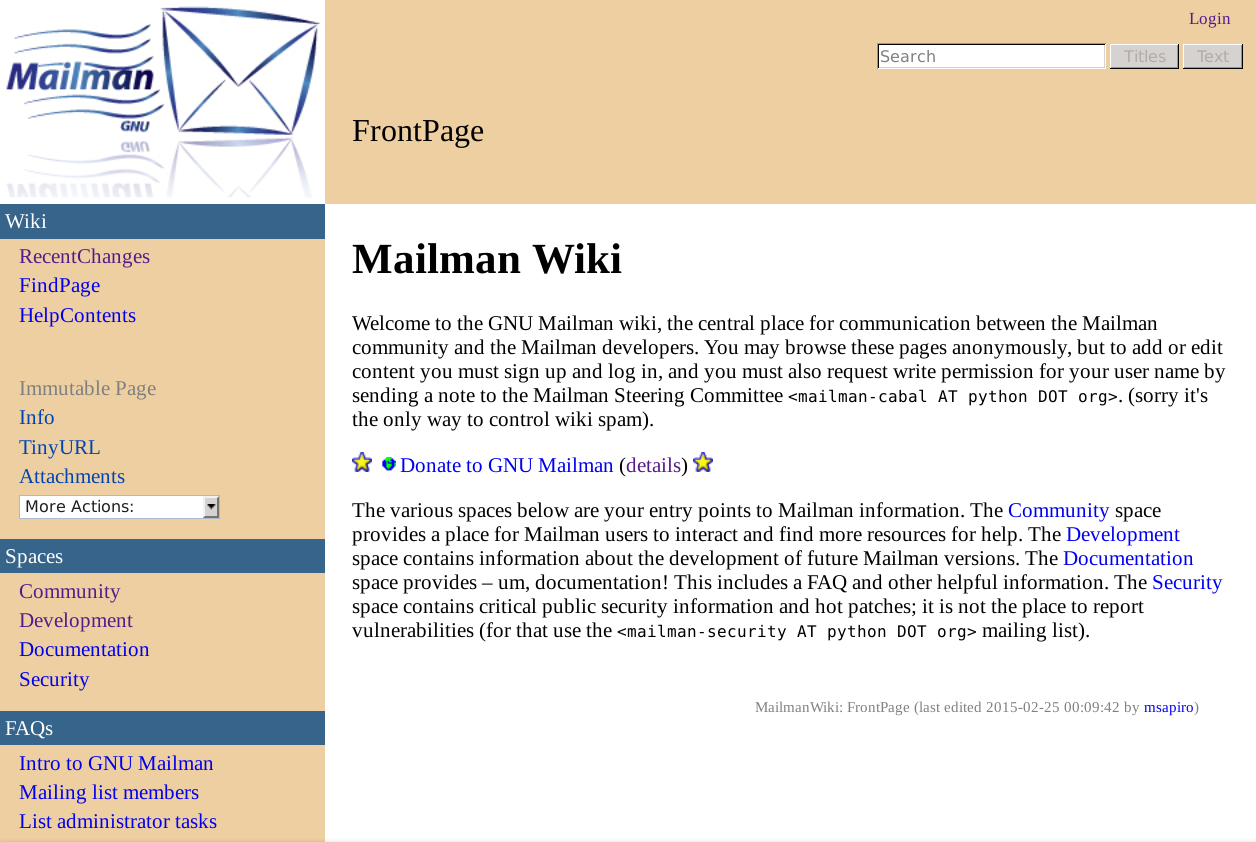
Alas, things stalled again for a while, perhaps due to other commitments of some of the volunteers needed to make the final transition occur, but in January the new Mailman Wiki was finally announced. But things didn’t stop there. One long-standing volunteer, Jim Tittsler, decided that the visual theme of the new wiki would be improved if it were made to match the other Mailman Web resources, and so he went and figured out how to make a MoinMoin theme to do the job! The new wiki just wouldn’t look as good, despite all the migrated content and the familiarity of MoinMoin, if it weren’t for the special theme that Jim put together.

The all-new Mailman Wiki with Jim Tittsler's theme

The all-new Mailman Wiki with Jim Tittsler's theme

There have been a few things to deal with after deploying the new wiki. Spam and vandalism have not been a problem because we have implemented a very strict editing policy where people have to request editing access. However, this does not prevent people from registering accounts, even if they never get to use them to do anything. To deal with this, we enabled textcha support for new account registrations, and we also enabled e-mail verification of new accounts. As a result, the considerable volume of new user profiles that were being created (potentially hundreds every hour) has been more or less eliminated.

It has to be said that throughout the process, once it got started in earnest, the Mailman development community has been fantastic, with constructive feedback and encouragement throughout. I have had disappointing things to say about the experience of being a volunteer with regard to certain projects and initiatives, but the Mailman project is not that kind of project. Within the limits of their powers, the Mailman custodians have done their best to enable this work and to see it through to the end.

Some Lessons

I am sure that offers of “for free” usage of certain proprietary tools and services are made in a genuinely generous way by companies like Atlassian who presumably feel that they are helping to make Free Software developers more productive. And I can only say that those interactions I experienced with Contegix, who were responsible for hosting the Confluence instance through which the old Mailman Wiki was deployed, were both constructive and polite. Nevertheless, proprietary solutions are ultimately disempowering: they take away the control over the working environment that users and developers need to have; they direct improvement efforts towards themselves and away from Free Software solutions; they also serve as a means of dissuading people from adopting competing Free Software products by giving an indication that only they can meet the rigorous demands of the activity concerned.

I saw a position in the Norwegian public sector not so long ago for someone who would manage and enhance a Confluence installation. While it is not for me to dictate the tools people choose to do their work, it seems to me that such effort would be better spent enhancing Free Software products and infrastructure instead of remedying the deficiencies of a tool over which the customer ultimately has no control, to which the customer is bound, and where the expertise being cultivated is relevant only to a single product for as long as that product is kept viable by its vendor. Such strategic mistakes occur all too frequently in the Norwegian public sector, with its infatuation with proprietary products and services, but those of us not constrained by such habits can make better choices when choosing tools for our own endeavours.

I encourage everyone to support Free Software tools when choosing solutions for your projects. It may be the case that such tools may not at first offer precisely the features you might be looking for, and you might be tempted to accept an offer of a “for free” product or to use a no-cost “cloud” service, and such things may appear to offer an easier path when you might otherwise be confronted with a choice of hosting solutions and deployment issues. But there are whole communities out there who can offer advice and will support their Free Software project, and there are Free Software organisations who will help you deploy your choice of tools, perhaps even having it ready to use as part of their existing infrastructure.

In the end, by embracing Free Software, you get the control you need over your content in order to manage it sustainably. Surely that is better than having some random company in charge, with the ever-present risk of them one day deciding to discontinue their service and/or, with barely enough notice, discard your data.

Leaving the PSF

Sunday, May 10th, 2015

It didn’t all start with a poorly-considered April Fools’ joke about hosting a Python conference in Cuba, but the resulting private mailing list discussion managed to persuade me not to continue as a voting member of the Python Software Foundation (PSF). In recent years, upon returning from vacation, discovering tens if not hundreds of messages whipping up a frenzy about some topic supposedly pertinent to the activities of the PSF, and reading through such messages as if I should inform my own position on the matter, was undoubtedly one of the chores of being a member. This time, my vacation plans were slightly unusual, so I was at least spared the surprise of getting the bulk of people’s opinions in one big serving.

I was invited to participate in the PSF at a time when it was an invitation-only affair. My own modest contributions to the EuroPython conference were the motivating factor, and it would seem that I hadn’t alienated enough people for my nomination to be opposed. (This cannot be said for some other people who did eventually become members as well after their opponents presumably realised the unkindness of their ways.) Being asked to participate was an honour, although I remarked at the time that I wasn’t sure what contribution I might make to such an organisation. Becoming a Fellow of the FSFE was an active choice I made myself because I align myself closely with the agenda the FSFE chooses to pursue, but the PSF is somewhat more vague or more ambivalent about its own agenda: promoting Python is all very well, but should the organisation promote proprietary software that increases Python adoption, or would this undermine the foundations on which Python was built and is sustained? Being invited to participate in an organisation with often unclear objectives combines a degree of passivity with an awareness that some of the decisions being taken may well contradict some of the principles I have actively chosen to support in other organisations. Such as the FSFE, of course.

Don’t get me wrong: there are a lot of vital activities performed within the PSF. For instance, the organisation has a genuine need to enforce its trademarks and to stop other people from claiming the Python name as their own, and the membership can indeed assist in such matters, as can the wider community. But looking at my archives of the private membership mailing list, a lot of noise has been produced on other, more mundane matters. For a long time, it seemed as if the only business of the PSF membership – as opposed to the board who actually make the big decisions – was to nominate and vote on new members, thus giving the organisation the appearance of only really existing for its own sake. Fortunately, organisational reform has made the matter of recruiting members largely obsolete, and some initiatives have motivated other, more meaningful activities. However, I cannot be the only person who has noted that such activities could largely be pursued outside the PSF and within the broader community instead, as indeed these activities typically are.

PyCon

Some of the more divisive topics that have caused the most noise have had some connection with PyCon: the North American Python conference that mostly replaced the previous International Python Conference series (from back when people thought that conferences had to be professionally organised and run, in contrast to PyCon and most, if not all, other significant Python conferences today). Indeed, this lack of separation between the PSF and PyCon has been a significant concern of mine. I will probably never attend a PyCon, partly because it resides in North America as a physical event, partly because its size makes it completely uninteresting to me as an attendee, and largely because I increasingly find the programme uninteresting for a variety of other reasons. When the PSF members’ time is spent discussing or at least exposed to the discussion of PyCon business, it can just add to the burden of membership for those who wish to focus on the supposed core objectives of the organisation.

What may well be worse, however, is that PyCon exposes the PSF to substantial liability issues. As the conference headed along a trajectory of seemingly desirable and ambitious growth, it collided with the economic downturn caused by the global financial crisis of 2008, incurring a not insignificant loss. Fortunately, this outcome has not since been repeated, and the organisation had sufficient liquidity to avoid any serious consequences. Some have argued that it was precisely because profits from previous years’ conferences had been accumulated that the organisation was able to pay its bills, but such good fortune cannot explain away the fundamental liability and the risks it brings to the viability of the organisation, especially if fortune happens not to be on its side in future.

Volunteering

In recent times, I have been more sharply focused on the way volunteers are treated by organisations who rely on their services to fulfil their mission. Sadly, the PSF has exhibited a poor record in various respects on this matter. Once upon a time, the Python language Web site was redesigned under contract, but the burden of maintenance fell on community volunteers. Over time, discontentment forced the decision to change the technology and a specification was drawn up under a degree of consultation. Unfortunately, the priorities of certain stakeholders – that is, community volunteers doing a fair amount of hard work in their own time – were either ignored or belittled, leaving them confronted with either having to adapt to a suboptimal workflow not of their own choosing, as well as spending time and energy developing that workflow, or just quitting and leaving it to other people to tidy up the mess that those other people (and the hired contractors) had made.

Understandably, the volunteers quit, leaving a gap in the Web site functionality that took a year to reinstate. But what was most disappointing was the way those volunteers were branded as uncooperative and irresponsible in an act of revisionism by those who clearly failed to appreciate the magnitude of the efforts of those volunteers in the first place. Indeed, the views of the affected volunteers were even belittled when efforts were championed to finally restore the functionality, with it being stated by one motivated individual that the history of the problem was not of his concern. When people cannot themselves choose the basis of their own involvement in a volunteer-run organisation without being vilified for letting people down or for “holding the organisation to ransom”, the latter being a remarkable accusation given the professionalism that was actually shown in supporting a transition to other volunteers, one must question whether such an organisation deserves to attract any volunteers at all.

Politics

As discussion heated up over the PyCon Cuba affair, the usual clash of political views emerged, with each side accusing the other of ignorance and not understanding the political or cultural situation, apparently blinkered by their own cultural and political biases. I remember brazen (and ill-informed) political advocacy being a component in one of the Python community blogging “planets” before I found the other one, back when there was a confusing level of duplication between the two and when nobody knew which one was the “real” one (which now appears to consist of a lot of repetition and veiled commercial advertising), and I find it infuriating when people decide to use such matters as an excuse to lecture others and to promote their own political preferences.

I have become aware of a degree of hostility within the PSF towards the Free Software Foundation, with the latter being regarded as a “political” organisation, perhaps due to hard feelings experienced when the FSF had to educate the custodians of Python about software licensing (which really came about in the first place because of the way Python development had been moved around, causing various legal representatives to play around with the licensing, arguably to make their own mark and to stop others getting all the credit). And I detect a reluctance in some quarters to defend software freedom within the PSF, with a reluctance to align the PSF with other entities that support software and digital freedoms. At least the FSF can be said to have an honest political agenda, where those who support it more or less know where they stand.

In contrast, the PSF seems to cultivate all kinds of internal squabbling and agenda-setting: true politics in the worst sense of the word. On one occasion I was more or less told that my opinion was not welcome or, indeed, could ever be of interest on a topic related to diversity. Thankfully, diversity politics moved to a dedicated mailing list and I was thereafter mostly able to avoid being told by another Anglo-Saxon male that my own perspectives didn’t matter on that or on any other topic. How it is that someone I don’t actually know can presume to know in any detail what perspectives or experiences I might have to offer on any matter remains something of a mystery to me.

Looking through my archives, there appears to be a lot of noise, squabbling, quipping, and recrimination over the last five years or so. In the midst of the recent finger-wagging, someone dared to mention that maybe Cubans, wherever they are, might actually deserve to have a conference. Indeed, other places were mentioned where the people who live there, through no fault of their own, would also be the object of political grandstanding instead of being treated like normal people wanting to participate in a wider community.

I mostly regard April Fools’ jokes as part of a tedious tradition, part of the circus that distracts people away from genuine matters of concern, perhaps even an avenue of passive aggression in certain circles, a way to bully people and then insist – as cowards do – that it was “just a joke”. The lack of a separation of the PSF’s interests combined with the allure of the circus conspired to make fools out of the people involved in creating the joke and of many in the accompanying debate. I find myself uninterested in spending my own time indulging such distractions, especially when those distractions are products of flaws in the organisation that nobody wishes to fix, and when there are more immediate and necessary activities to pursue in the wider arena of Free Software that, as a movement in its own right, some in the PSF practically refuse to acknowledge.

Effects

Leaving the PSF won’t really change any of my commitments, but it will at least reduce the level of background noise I have to deal with. Such an underwhelming and unfortunate assessment is something the organisation will have to rectify in time if it wishes to remain relevant and to deserve the continued involvement of its members. I do have confidence in some of the reform and improvement processes being conducted by volunteers with too little time of their own to pursue them, and I hope that they make the organisation a substantially better and more effective one, as they continue to play to an audience of people with much to say but, more often than not, little to add.

I would have been tempted to remain in the PSF and to pursue various initiatives if the organisation were a multiplier of effect for any given input of effort. Instead, it currently acts as a divider of effect for all the effort one would apparently need to put in to achieve anything. That isn’t how any organisation, let alone one relying on volunteer time and commitment, should be functioning.

A Footnote

On political matters and accusations of ignorance being traded, my own patience is wearing thin indeed, and this probably nudged me into finally making this decision. It probably doesn’t help that I recently made a trip to Britain where election season has been in full swing, with unashamed displays of wilful idiocy openly paraded on a range of topics, indulged by the curated ignorance of the masses, with the continued destruction of British society, nature and the economy looking inevitable as the perpetrators insist they know best now and will undoubtedly in the future protest their innocence when challenged on the legacy of their ruinous rule, adopting the “it wasn’t me” manner of a petulant schoolchild so befitting of the basis of the nepotism that got most of them where they are today.

On Python’s Type Annotation Strategy

Thursday, May 7th, 2015

Once again, I was reading an article, became tempted to comment, and then found myself writing such a long response that I felt it would be better here. (The article is initially for subscribers of LWN.net, with which I have a subscription thanks to their generosity in giving FSFE Fellows access upon their Fellowship renewal. The article will eventually become available to everyone after one week, which is the site’s policy. Maybe this blog post will encourage you to read the article, either eventually or as a subscriber.)

It was asserted that Haskell – a statically-typed language – doesn’t need type annotations because its type inference mechanisms are usually good enough. But generally, functional programming languages have effective type inference because of other constraints described by the author of the program. Now, Python could also benefit from such an approach if the language developers were willing to concede a few important properties of the language, but up to now the view has been that if a single property of Python is sacrificed then “it isn’t Python”. That’s why PyPy has had to pursue full compatibility, why the Nuitka author (who has done a heroic job despite detractors claiming it isn’t a worthwhile job) is trying to provide full compatibility, and why things like Cython and Shedskin get pushed to one side and/or ignored by everybody as they keep adding more stuff to the language themselves, which actually isn’t going to help make programs more predictable for the most part.

In the debate, an apparently irritated BDFL was served up a statement of his own from twelve years previously on the topic of Python no longer being Python once people start to change the syntax of the language to meet new needs. What type annotations risk is Python, as people read it, becoming something very different to what they are used to and what they expect. Look at some of the examples of type annotations and apart from the shapes of the brackets, you could start to think you were looking at parameterised template code written in C++. Python’s strength is the way you can write generic code that will work as long as the values you give a part of the program can support the operations being done, and the way that non-compliant values are properly rejected through exceptions being raised. If everybody starts writing “int, int, int” everywhere, the re-usability of code will really suffer; if people still want to express the type constraints properly, the conciseness of the code will really suffer because the type annotations will be necessarily complicated.

I think the BDFL has heard too many complaints about Python programs crashing over the years, but nobody has given him a better strategy than type annotations/declarations for dealing with such criticism. But then again, the dominant conservatism of Python language and CPython implementation development has perhaps resulted in that group being ill-equipped or ill-positioned to offer anything better. Personally, I see the necessary innovation coming from beyond the core development community, but then again, my own perspective is coloured by my own experiences and disappointments with the direction of Python.

Maybe progress – and a satisfactory remedy for negative perceptions of Python program reliability – will only be made when everybody finally has the debate about what Python really is that so many have tried to avoid having over the years. And no: “exactly what CPython 3.x happens to support” is not – and never has been – a valid circuit-breaker on that particular debate.

International Day Against DRM

Wednesday, May 6th, 2015

A discussion on the International Day Against DRM got my attention, and instead of replying on the site in question, I thought I’d write something about it here. The assertion was that “this war has been lost“, to which it was noted that “ownership isn’t for everyone”.

True enough: people are becoming conditioned to accept that they can enjoy nice things but not have any control of them or, indeed, any right to secure them for themselves. So, you effectively have the likes of Spotify effectively reinventing commercial radio where the interface is so soul-crushingly awful that it’s almost more convenient to have to call the radio station to request that they play a track. Or at least it was when I was confronted with it on someone’s smartphone fairly recently.

Meanwhile, the ignorant will happily trumpet the corporate propaganda claiming that those demanding digital rights are “communists”, when the right to own things to enjoy on your own terms has actually been taken away by those corporations and their pocket legislators. Maybe people should remember that when they’re next out shopping for gadgets or, heaven forbid, voting in a public election.

An Aside on Music

Getting older means that one can happily and justifiably regard a lot of new cultural output as inferior to what came before, which means that if one happened to stop buying music when DRM got imposed, deciding not to bother with new music doesn’t create such a big problem after all. I have plenty of legitimately purchased music to listen to already, and I didn’t need to have the potential enjoyment of any new work inconvenienced by only being able to play that work on certain devices or on somebody else’s terms.

Naturally, the music industry blames the decline in new music sales on “piracy”, but in fact people just got used to getting their music in more convenient ways, or they decided that they already have enough music and don’t really need any more. I remember how some people would buy a CD or two every weekend just as a treat or to have something new to listen to, and the music industry made a very nice living from this convenient siphoning of society’s disposable income, but that was just a bubble: the prices were low enough for people to not really miss the money, but the prices were also high enough and provided generous-enough margins for the music industry to make a lot of money from such casual purchasers while they could.

Note that I emphasised “potential” above. That’s another thing that the music business got away with for years: the loyalty of their audiences. How many people bought new material from an artist they liked only to discover that it wasn’t as good as they’d hoped? After a while, people just lose interest. This despite the effective state subsidy of the music business through public broadcasters endlessly and annoyingly playing and promoting that industry’s proprietary content. And there is music from even a few years ago that you wouldn’t be able to persuade anyone to sell you any more. It is like they don’t want your money, or at least if it is not being handed over on precisely their terms, which for a long time now has seemed to involve the customer going back and paying them again and again for something they already bought (under threat of legal penalties for “format shifting” in order to compel such repeat business).

It isn’t a surprise that the focus now is on music (and video) streaming and that actually buying media to play offline is becoming harder and harder. The focus of the content industries is on making it more and more difficult to acquire their content in ways that make it possible to experience that content on sustainable terms. Just as standard music CDs became corrupted with DRM mechanisms that bring future access to the content into doubt, so have newer technologies been encumbered with inconvenient and illegitimate mechanisms to deny people legitimate access. And as the campaign against DRM notes, some of the outcomes are simply discriminatory and shameful.

Our Legacy

Even content that has not been “protected” has proven difficult to recover simply due to technological progress and material, cultural and intellectual decay. It would appal many people that anyone would put additional barriers around content just to maximise revenues when the risk is that the “protectors” of such content will either inadvertently (their competence not being particularly noted) or deliberately (their vindictiveness being especially noted) consign that content to the black hole of prehistory just to stop anyone else actually enjoying it without them benefiting from the act. In some cases, one would think that content destruction is really what the supposed guardians of the content actually want, especially when there’s no more easy money to be made.

Of course, such profiteers don’t actually care about things like cultural legacy or the historical record, but society should care about such things. Regardless of who paid for something to be made – and frequently it was the artist, with the publishers only really offering financing that would most appropriately be described as “predatory” – such content is part of our culture and our legacy. That is why we should resist DRM, we should not support its proponents when buying devices and content or when electing our representatives, and it is why we should try and limit copyright terms so that legacy content may stand a chance of being recovered and responsibly archived.

We owe it to ourselves and to future generations to resist DRM.

EOMA-68: The Return

Wednesday, April 8th, 2015

It is hard to believe that almost two years have passed since I criticised the Ubuntu Edge crowd-funding campaign for being a distraction from true open hardware initiatives (becoming one which also failed to reach its funding target, but was presumably good advertising for Ubuntu’s mobile efforts for a short while). Since then, the custodians of Ubuntu have pressed on with their publicity stunts, the most recent of which involving limited initial availability of an Ubuntu-branded smartphone that may very well have been shipping without the corresponding source code for the GPL-licensed software being available, even though it is now claimed that this issue has been remedied. Given the problems with the same chipset vendor in other products, I personally cannot help feeling that the matter might need more investigation, but then again, I personally do not have time to chase up licence compliance in other people’s products, either.

Meanwhile, some genuine open hardware initiatives were mentioned in that critique of Ubuntu’s mobile strategy: GTA04 is the continuing effort to produce a smartphone that continues the legacy of the Openmoko Neo FreeRunner, whose experiences are now helping to produce the Neo900 evolution of the Nokia N900 smartphone; Novena is an open hardware laptop that was eventually successfully crowd-funded and is in the process of shipping to backers; OpenPandora is a handheld games console, the experiences from which have since been harnessed to initiate the DragonBox Pyra product with a very similar physical profile and target audience. There is a degree of collaboration and continuity within some of these projects, too: the instigator of the GTA04 project is assisting with the Neo900 and the Pyra, for example, partly because these projects use largely the same hardware platform. And, of course, GNU/Linux is the foundation of the software for all this hardware.

But in general, open hardware projects remain fairly isolated entities, perhaps only clustering into groups around particular chipsets or hardware platforms. And when it comes to developing a physical device, the amount of re-use and sharing between projects is perhaps less than we might have come to expect from software, particularly Free Software. Not that this has necessarily slowed the deluge of boards, devices, products and crowd-funding campaigns: everywhere you look, there’s a new Arduino variant or something claiming to be the next big thing in the realm of the “Internet of Things” (IoT), but after a while one gets the impression that it is the same thing being funded and sold, over and over again, with the audience probably not realising that it has all mostly been done before.

The Case for Modularity

Against this backdrop, there is one interesting and somewhat unusual initiative that I have only briefly mentioned before: the development of the EOMA-68 (Embedded Open Modular Architecture 68) standard along with products to demonstrate it. Unlike the average single-board computer or system-on-module board, EOMA-68 attempts to define a widely-used modular computing unit which is also a complete computing device, delegating input (keyboards, mice, storage) and output (displays) to other devices. It has often been repeated that today phones are just general-purpose computers that happen to be able to make calls, and the same can be said for a lot of consumer electronics equipment that traditionally were either much simpler devices or which only employed special-purpose computing units to perform their work: televisions are a reasonably illustrative example of this.

And of course, computers as we know them come in all shapes and sizes now: phones, media players, handhelds, tablets, netbooks, laptops, desktops, workstations, and so on. But most of these devices are not built to be upgraded when the core computing part of them becomes obsolete or, at the very least, less attractive than the computing features of newer devices, nor can the purchaser mix and match the computing part of one device with the potentially more attractive parts of another: one kind of smart television may have a much better screen but a poorer user interface that one would want to replace, for example. There are workarounds – some people use USB-based “plug computers” to give their televisions “smart” capabilities – but when you buy a device, you typically have to settle for the bundled software and computing hardware (even if the software might eventually be modifiable thanks to the role of the GPL, subject to constraints imposed by manufacturers that might prevent modification).

With a modular computing unit, the element of choice is obviously enhanced, but it also helps those developing open hardware. First of all, the interface to the computing unit is well-defined, meaning that the designers of a device need not be overly concerned with the way the general-purpose computing functionality is to be provided beyond the physical demands of that particular module and the facilities provided by it. Beyond such constraints, being able to rely on a tested functional element, designers can focus on the elements of their device that differentiate it from other devices without having to master the integration of their own components of interest with those required for the computing functionality in one “make or break” hardware design that might prove too demanding to get right first time (or even second or third time). Prototyping complicated circuit designs can quickly incur considerable costs, and eliminating complexity from what might be described as the “peripheral board” – the part providing the input and output capabilities and the character of a particular device – not only reduces the risk of getting things wrong, but it could make the production of that board cheaper, too. And that might open up device design to a broader group of participants.

As Nico Rikken explains, EOMA-68 promises to offer benefits for hardware designers, software developers and customers. Modularity does make sense if properly considered, which is perhaps why other modularity initiatives like Phonebloks have plenty of critics even though they share the same worthy objectives of reducing waste and avoiding device obsolescence: with vague statements about modularity and the hint of everything being interchangeable and interoperating with everything, one cannot help be skeptical about the potential complexity and interoperability problems that could result, not to mention the ergonomic issues that most people can easily relate to. By focusing on the general-purpose computing aspect of modularity, EOMA-68 addresses the most important part of the hardware for Free Software and delegates modularity elsewhere in the system to other initiatives that do not claim to do it all.

A Few False Starts

Unfortunately, not everything has gone precisely according to schedule with EOMA-68 so far. After originally surfacing as part of an initiative to make a competitive ARM-based netbook, the plan was to make computing modules and “engineering boards” on the way to delivering a complete product, and the progress of the first module can be followed on the Allwinner A10 news page on the Rhombus Tech Web site. From initial interest from various parties at the start of 2012, and through a considerable amount of activity, by May 2013, working A10 boards were demonstrated running Debian Wheezy. And a follow-up board employing the Allwinner A20 instead of the A10 was demonstrated running Debian at the end of October 2014 as part of a micro-desktop solution.

One might have thought that these devices would be more widely available by now, particularly as development began in 2012 on a tablet board to complement the computing modules, with apparently steady progress being made. Now, the development of this tablet was driven by the opportunity to collaborate with the Vivaldi tablet project, whose own product had been rendered unusable for Free Software usage by the usual product iteration performed behind the scenes by the contract manufacturer changing the components in use without notice (as is often experienced by those buying computers to run Free Software operating systems, only to discover that the wireless chipset, say, is no longer one that is supported by Free Software). With this increased collaboration with KDE-driven hardware initiatives (Improv and Vivaldi), efforts seemingly became directed towards satisfying potential customers within the framework of those other initiatives, so that to acquire the micro-engineering board one would seek to purchase an Improv board instead, and to obtain a complete tablet product one would place an advance order for the Vivaldi tablet instead of anything previously under development.

Somehow during 2014, the collaboration between the participants in this broader initiative appears to have broken down, with there undoubtedly being different perspectives on the sequence of events that led to the cancellation of Improv and Vivaldi. Trawling the mailing list archives gives more detail but not much more clarity, and it can perhaps only be said that mistakes may have been made and that everybody learned new things about certain aspects of doing business with other people. The effect, especially in light of the deluge of new and shiny products for casual observers to purchase instead of engaging in this community, and with many people presumably being told that their Vivaldi tablet would not be shipping after all, probably meant that many people lost interest and, indeed, hope that there would be anything worth holding out for.

The Show Goes On

One might have thought that such a setback would have brought about the end of the initiative, but its instigator shows no sign of quitting, probably because genuine hardware has been made, and other opportunities and collaborations have been created on the way. Initially, the focus was on an ARM-based netbook or tablet that would run Free Software without the vendor neglecting to provide the complete corresponding source for things like the Linux kernel and bootloader required to operate the device. This requirement for licence compliance has not disappeared or diminished, with continuing scrutiny placed on vendors to make sure that they are not just throwing binaries over the wall.

But as experience was gained in evaluating suitable CPUs, it was not only ARM CPUs that were found to have the necessary support characteristics for software freedom as well as for low power consumption. The Ingenic jz4775, a sibling of the rather less capable jz4720 used by the Ben NanoNote, uses the MIPS architecture and may well be fully supported by the mainline Linux kernel in the near future; the ICubeCorp IC1T is a more exotic CPU that can be supported by Free Software toolchains and should be able to run the Linux kernel in addition to Android. Alongside these, the A20 remains the most suitable of the options from Allwinner, whose products have always been competitively priced (which has also been a consideration), but there are other ARM derivatives that would be more interesting from a vendor cooperation perspective, notably the TI AM389x series of CPUs.

Meanwhile, after years of questions about whether a crowd-funding campaign would be started to attract customers and to get the different pieces of hardware built in quantity, plans for such a campaign are now underway. While initial calls for a campaign may have been premature, I now think that the time is right: people have been using the hardware already produced for some time, and considerable experience has been amassed along the way up to this point; the risks should be substantially lower than quite a few other crowd-funding campaigns that seem to be approved and funded these days. Not that anyone should seek to conceal the nature of crowd-funding and the in-built element of risk associated with such campaigns, of course: it is not the same as buying a product from a store.

Nevertheless, I would be very interested to see this hardware being made, and I am even on record as having said so. Part of this is selfishness: I could do with some newer, quieter, less power-consuming hardware. But I also think that a choice of different computing modules, supporting Free Software operating systems out of the box, with some of them candidates for FSF endorsement, and offering a diversity of architectures, would be beneficial to a sustainable computing infrastructure in the longer term. If you also think so, maybe you should follow the progress of EOMA-68 over the coming weeks and months, too.

Open Hardware and Free Software: Not Just For The Geeks

Saturday, April 4th, 2015

Having seen my previous article about the Fairphone initiative’s unfortunate choice of technologies mentioned in various discussions about the Fairphone, I feel a certain responsibility to follow up on some of the topics and views that tend to get aired in these discussions. In response to an article about an “open operating system” for the Fairphone, a rather solid comment was made about how the initiative still seems to be approaching the problem from the wrong angle.

Because the article comments have been delegated to a proprietary service that may at some point “garbage-collect” them from the public record, I reproduce the comment here (and I also expanded the link previously provided by a link-shortening service for similar and other reasons):

You are having it all upside down.
Just make your platform open instead of using proprietary chipsets with binary blobs! Then porting Firefox OS to the Fairphone would be easy as pie.

Not listening to the people who said that only free software running on open hardware would be really fair is exactly what brought you this mess: Our approach to software and ongoing support for the first Fairphones
It is also why I advised all of my friends and acquaintances not to order a Fairphone until it becomes a platform that respects user freedom. Turns out I was more than right.
If the Fairphone was an open platform that could run Firefox OS, Replicant or pure Debian, I would tell everybody in need of a cellphone to buy one.

I don’t know the person who wrote this comment, but it is very well-formulated, and one wouldn’t think that there would be much to add. Unfortunately, some people seem to carry around their own misconceptions about some of the concepts mentioned above, and unfortunately, they are quite happy to propagate those misconceptions as if they were indisputable facts. Below, I state the real facts in the headings and quote each one of the somewhat less truthful misconceptions for further scrutiny.

Open Hardware and Free Software is for Everyone

Fairphone should not make the mistake of producing a phone for geeks. Instead, it should become a phone for everyone.

Just because people have an opinion about technology and wish to see certain guarantees made about the nature of that technology does not mean that the result is “for geeks”. In fact, making the hardware open means that more people can figure things out about it, improve it, understand it, and improve the way it works and the software that uses it. Making the software truly open means that more people can change it, fix it, enhance it, and extend the usable life of the device. All of this benefits everyone, whereas closed hardware and proprietary software ultimately benefit only the small groups of people who respectively designed the device and wrote the software, both of whom being very likely to lose interest in sustaining the life of that product as soon as they have another one they want to sell you. (And often, in the case of the hardware, as soon as it leaves the factory.)

User Freedom Means Exactly User Freedom

‘User freedom’ is often used when actually ‘developers freedom’ is meant. It is more of an ideology.

Incorrect! Those of us who use the term Free Software know exactly what we mean: it is the freedom of the end-user to exercise precisely those privileges that have resulted in the work being produced and delivered to them. Now, there are people who advocate “permissive licences” that do favour developers in that they allow people to use the work of others and to then provide a piece of software under conditions that grants the end-user only limited privileges, taking away those privileges to see how the entire work is constructed, along with those that allow the entire work to be improved and shared. Whether one sees either of these as an ideology, presumably emphasising one’s own “pragmatism” in contrast, is largely irrelevant because the genuine pragmatism involved in Free Software and the propagation of a broader set of privileges actually delivers sustainability: users – genuine end-users, not middle-men – get the freedom to participate in how the product turns out, and crucially, how it lives on after the original producer has decided to go off and do something else.

Openness Does Not Preclude Fanciness (But Security Requires Openness)

What people want is: user friendly interface, security/privacy, good specs and ability to install apps and games. […] OpenSource is a nice idea, but has its disadvantages too: who is caring about quality?

It’s just too easy for people to believe claims about privacy and security, even after everybody found out that they were targets of widespread surveillance, even after various large corporations who presumably care about their reputations have either lost the personal details of their users to criminals or have shared those details with others (who also have criminal or unethical intent), and when believing the sales-pitch about total privacy and robust security, those people will happily reassure themselves and others that no company would allow its reputation to be damaged by any breach of privacy or security! But there are no guarantees of security or privacy if you cannot trust the systems you use, and there is no way of trusting them without being able to inspect how they work. More than ever, people need genuine guarantees of security and privacy – not reassurances from salesmen and advertisers – and the best way to start off on the path towards such guarantees is to be able to deploy Free Software on a device that you fully control.

And as for quality, user-friendliness and all the desirable stuff: how many people use products like Firefox in its various forms every single day? Such Free Software solutions have not merely set the standard over the years, but they have kept technologies like the Web relevant and viable, in stark contrast to proprietary bundled programs like Internet Explorer that have actually impaired technological and social progress, with “IE” doing its bit by exhibiting a poor record of adherence to standards and a continuous parade of functionality and security bugs, not to mention constant usability frustrations endured by its unfortunate (and frequently involuntary) audience of users.

Your Priorities Make Free Software Important

I found the following comment to be instructive:

For me open source isn’t important. My priorities are longevity/updates, support, safety/privacy.

The problem is this: how can you guarantee longevity, updates, support, safety and privacy without openness? Safety and privacy would require you to have blind trust in someone whose claims you cannot verify. Longevity, updates and support require you to rely on the original producer’s continued interest in the product that you have just purchased from them, and should it become more profitable for them to focus on other products (that they might want you to buy instead of continuing to use the one you have), you might be able to rely on the goodwill of that producer to transfer their responsibilities to others to do the thankless tasks of maintenance and support. But it may well be the case that no amount of money will be able to keep that product viable for you: the producer may simply refuse to support it or to let others support it. Perhaps some people may step in and reverse-engineer the product and make an effort to keep it viable, but wouldn’t it be better to have an open product to start with, where people can choose how it is maintained – and thus sustained – for as long as people still want to use it?

Concepts like open hardware and Free Software sound like topics for the particularly-interested, but they provide the foundations for those topics of increasing interest and attention that people claim to care so much about. Everybody deserves things like choice, democracy, privacy, security, safety, control over their own lives and destinies, and so on. Closed hardware and proprietary software may be used on lots of devices, and people may be getting a lot of use out of those devices, but the users of those devices enjoy the benefits only as long as it remains in the interests of the producers of those devices and the accompanying software to allow them to do so. Furthermore, few or none of those users can be sure whether any of those important things – their rights – are being impaired by their use of those devices. Are their communications being intercepted, collected, analysed? Few people would ever know.

Free Software and open hardware empower their users with the control that proprietary technologies deny their users. But shouldn’t everybody be able to benefit from such control? That’s why a device that is open hardware and which runs Free Software really is for everyone, not just for “geeks”.

The BBC Micro and the BBC Micro Bit

Sunday, March 22nd, 2015

At least on certain parts of the Internet as well as in other channels, there has been a degree of excitement about the announcement by the BBC of a computing device called the “Micro Bit“, with the BBC’s plan to give one of these devices to each child starting secondary school, presumably in September 2015, attracting particular attention amongst technology observers and television licence fee-payers alike. Details of the device are a little vague at the moment, but the announcement along with discussions of the role of the corporation and previous initiatives of this nature provides me with an opportunity to look back at the original BBC Microcomputer, evaluate some of the criticisms (and myths) around the associated Computer Literacy Project, and to consider the things that were done right and wrong, with the latter hopefully not about to be repeated in this latest endeavour.

As the public record reveals, at the start of the 1980s, the BBC wanted to engage its audience beyond television programmes describing the growing microcomputer revolution, and it was decided that to do this and to increase computer literacy generally, it would need to be able to demonstrate various concepts and technologies on a platform that would be able to support the range of activities to which computers were being put to use. Naturally, a demanding specification was constructed – clearly, the scope of microcomputing was increasing rapidly, and there was a lot to demonstrate – and various manufacturers were invited to deliver products that could be used as this reference platform. History indicates that a certain amount of acrimony followed – a complete description of which could fill an entire article of its own – but ultimately only Acorn Computers managed to deliver a machine that could do what the corporation was asking for.

An Ambitious Specification

It is worth considering what the BBC Micro was offering in 1981, especially when considering ill-informed criticism of the machine’s specifications by people who either prefer other systems or who felt that participating in the development of such a machine was none of the corporation’s business. The technologies to be showcased by the BBC’s programme-makers and supported by the materials and software developed for the machine included full-colour graphics, multi-channel sound, 80-column text, Viewdata/Teletext, cassette and diskette storage, local area networking, interfacing to printers, joysticks and other input/output devices, as well as to things like robots and user-developed devices. Although it is easy to pick out one or two of these requirements, move forwards a year or two, increase the budget two- or three-fold, or any combination of these things, and to nominate various other computers, there really were few existing systems that could deliver all of the above, at least at an affordable price at the time.

Some microcomputers of the early 1980s
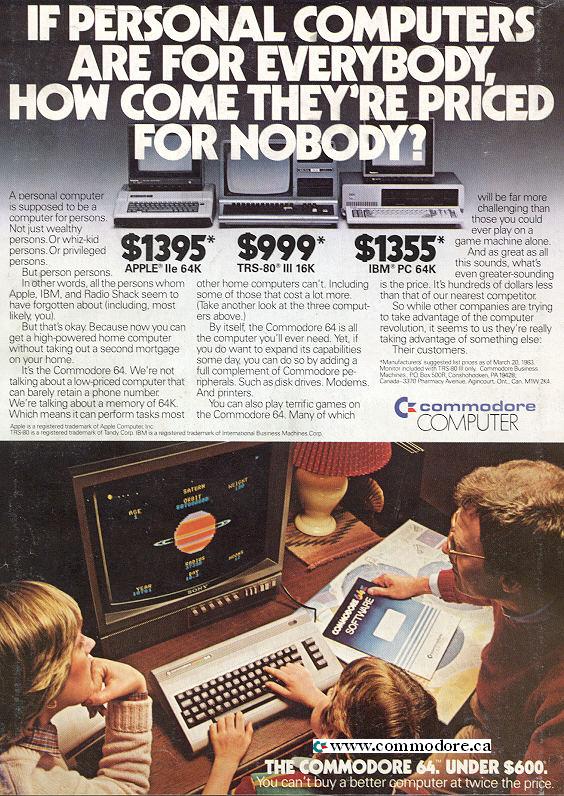
Computer RAM Text Graphics Year Price
Apple II Plus Up to 64K 40 x 25 (upper case only) 280 x 192 (6 colours), 40 x 48 (16 colours) 1979 £1500 or more
Commodore PET 4032/8032 32K 40/80 x 25 Graphics characters (2 colours) 1980 £800 (4032), £1030 (8032) (including monochrome monitor)
Commodore VIC-20 5K 22 x 23 176 x 184 (8 colours) 1980 (1981 outside Japan) £199
IBM PC (Model 5150) 16K up to 256K 40/80 x 25 640 x 200 (2 colours), 320 x 200 (4 colours) 1981 £1736 (including monochrome monitor, presumably with 16K or 64K)
BBC Micro (Model B) 32K 80/40/20 x 32/24, Teletext 640 x 256 (2 colours), 320 x 256 (2/4 colours), 160 x 256 (4/8 colours) 1981 £399 (originally £335)
Research Machines LINK 480Z 64K (expandable to 256K) 40 x 24 (optional 80 x 24) 160 x 72, 80 x 72 (2 colours); expandable to 640 x 192 (2 colours), 320 x 192 (4 colours), 190 x 96 (8 colours or 16 shades) 1981 £818
ZX Spectrum 16K or 48K 32 x 24 256 x 192 (16 colours applied using attributes) 1982 £125 (16K), £175 (48K)
Commodore 64 64K 40 x 25 320 x 200 (16 colours applied using attributes) 1982 £399

Perhaps the closest competitor, already being used in a fairly limited fashion in educational establishments in the UK, was the Commodore PET. However, it is clear that despite the adaptability of that system, its display capabilities were becoming increasingly uncompetitive, and Commodore had chosen to focus on the chipsets that would power the VIC-20 and Commodore 64 instead. (The designer of the PET went on to make the very capable, and understandably more expensive, Victor 9000/Sirius 1.) That Apple products were notoriously expensive and, indeed, the target of Commodore’s aggressive advertising did not seem to prevent them from capturing the US education market from the PET, but they always remained severely uncompetitive in the UK as commentators of the time indeed noted.

Later, the ZX Spectrum and Commodore 64 were released. Technology was progressing rapidly, and in hindsight one might have advocated waiting around until more capable and cheaper products came to market. However, it can be argued that in fulfilling virtually all aspects of the ambitious specification and pricing, it would not be until the release of the Amstrad CPC series in 1984 that a suitable alternative product might have become available. Even then, these Amstrad computers actually benefited from the experience accumulated in the UK computing industry from the introduction of the BBC Micro: they were, if anything, an iteration within the same generation of microcomputers and would even have used the same 6502 CPU as the BBC Micro had it not been for time-to-market pressures and the readily-available expertise with the Zilog Z80 CPU amongst those in the development team. And yet, specific aspects of the specification would still be unfulfilled: the BBC Micro had hardware support for Teletext displays, although it would have been possible to emulate these with a bitmapped display and suitable software.

Arise Sir Clive

Much has been made of the disappointment of Sir Clive Sinclair that his computers were not adopted by the BBC as products to be endorsed and targeted at schools. Sinclair made his name developing products that were competitive on price, often seeking cost-reduction measures to reach attractive pricing levels, but such measures also served to make his products less desirable. If one reads reviews of microcomputers from the early 1980s, many reviewers explicitly mention the quality of the keyboard provided by the computers being reviewed: a “typewriter” keyboard with keys that “travel” appear to be much preferred over the “calculator” keyboards provided by computers like the ZX Spectrum, Oric 1 or Newbury NewBrain, and they appear to be vastly preferred over the “membrane” keyboards employed by the ZX80, ZX81 and Atari 400.

For target audiences in education, business, and in the home, it would have been inconceivable to promote a product with anything less than a “proper” keyboard. Ultimately, the world had to wait until the ZX Spectrum +2 released in 1986 for a Spectrum with such a keyboard, and that occurred only after the product line had been acquired by Amstrad. (One might also consider the ZX Spectrum+ in 1984, but its keyboard was more of a hybrid of the calculator keyboard that had been used before and the “full-travel” keyboards provided by its competitors.)

Some people claim that they owe nothing to the BBC Micro and everything to the ZX Spectrum (or, indeed, the computer they happened to own) for their careers in computing. Certainly, the BBC Micro was an expensive purchase for many people, although contrary to popular assertion it was not any more expensive than the Commodore 64 upon that computer’s introduction in the UK, and for those of us who wanted BBC compatibility at home on a more reasonable budget, the Acorn Electron was really the only other choice. But it would be as childish as the playground tribalism that had everyone insist that their computer was “the best” to insist that the BBC Micro had no influence on computer literacy in general, or on the expectations of what computer systems should provide. Many people who owned a ZX Spectrum freely admit that the BBC Micro coloured their experiences, some even subsequently seeking to buy one or one of its successors and to go on to build a successful software development career.

The Costly IBM PC

Some commentators seem to consider the BBC Micro as having been an unnecessary diversion from the widespread adoption of the IBM PC throughout British society. As was the case everywhere else, the de-facto “industry standard” of the PC architecture and DOS captured much of the business market and gradually invaded the education sector from the top down, although significantly better products existed both before and after its introduction. It is tempting with hindsight to believe that by placing an early bet on the success of the then-new PC architecture, business and education could have somehow benefited from standardising on the PC and DOS applications. And there has always been the persistent misguided belief amongst some people that schools should be training their pupils/students for a narrow version of “the world of work”, as opposed to educating them to be able to deal with all aspects of their lives once their school days are over.

What many people forget or fail to realise is that the early 1980s witnessed rapid technological improvement in microcomputing, that there were many different systems and platforms, some already successful and established (such as CP/M), and others arriving to disrupt ideas of what computing should be like (the Xerox Alto and Star having paved the way for the Apple Lisa and Macintosh, the Atari ST, and so on). It was not clear that the IBM PC would be successful at all: IBM had largely avoided embracing personal computing, and although the system was favourably reviewed and seen as having the potential for success, thanks to IBM’s extensive sales organisation, other giants of the mainframe and minicomputing era such as DEC and HP were pursuing their own personal computing strategies. Moreover, existing personal computers were becoming entrenched in certain markets, and early adopters were building a familiarity with those existing machines that was reflected in publications and materials available at the time.

Despite the technical advantages of the IBM PC over much of the competition at the beginning of the 1980s, it was also substantially more expensive than the mass-market products arriving in significant numbers, aimed at homes, schools and small businesses. With many people remaining intrigued but unconvinced by the need for a personal computer, it would have been impossible for a school to justify spending almost £2000 (probably around £8000 today) on something without proven educational value. Software would also need to be purchased, and the procurement of expensive and potentially non-localised products would have created even more controversy.

Ultimately, the Computer Literacy Project stimulated the production of a wide range of locally-produced products at relatively inexpensive prices, and while there may have been a few years of children learning BBC BASIC instead of one of the variants of BASIC for the IBM PC (before BASIC became a deprecated aspect of DOS-based computing), it is hard to argue that those children missed out on any valuable experience using DOS commands or specific DOS-based products, especially since DOS became a largely forgotten environment itself as technological progress introduced new paradigms and products, making “hard-wired”, product-specific experience obsolete.

The Good and the Bad

Not everything about the BBC Micro and its introduction can be considered unconditionally good. Choices needed to be made to deliver a product that could fulfil the desired specification within certain technological constraints. Some people like to criticise BBC BASIC as being “non-standard”, for example, which neglects the diversity of BASIC dialects that existed at the dawn of the 1980s. Typically, for such people “standard” equates to “Microsoft”, but back then Microsoft BASIC was a number of different things. Commodore famously paid a one-off licence fee to use Microsoft BASIC in its products, but the version for the Commodore 64 was regarded as lacking user-friendly support for graphics primitives and other interesting hardware features. Meanwhile, the MSX range of microcomputers featured Microsoft Extended BASIC which did provide convenient access to hardware features, although the MSX range of computers were not the success at the low end of the market that Microsoft had probably desired to complement its increasing influence at the higher end through the IBM PC. And it is informative in this regard to see just how many variants of Microsoft BASIC were produced, thanks to Microsoft’s widespread licensing of its software.

Nevertheless, the availability of one company’s products do not make a standard, particularly if interoperability between those products is limited. Neither BBC BASIC nor Microsoft BASIC can be regarded as anything other than de-facto standards in their own territories, and it is nonsensical to regard one as non-standard when the other has largely the same characteristics as a proprietary product in widespread use, even if it was licensed to others, as indeed both Microsoft BASIC and BBC BASIC were. Genuine attempts to standardise BASIC did indeed exist, notably BASICODE, which was used in the distribution of programs via public radio broadcasts. One suspects that people making casual remarks about standard and non-standard things remain unaware of such initiatives. Meanwhile, Acorn did deliver implementations of other standards-driven programming languages such as COMAL, Pascal, Logo, Lisp and Forth, largely adhering to any standards subject to the limitations of the hardware.

However, what undermined the BBC Micro and Acorn’s related initiatives over time was the control that they as a single vendor had over the platform and its technologies. At the time, a “winner takes all” mentality prevailed: Commodore under Jack Tramiel had declared a “price war” on other vendors and had caused difficulties for new and established manufacturers alike, with Atari eventually being sold to Tramiel (who had resigned from Commodore) by Warner Communications, but many companies disappeared or were absorbed by others before half of the decade had passed. Indeed, Acorn, who had released the Electron to compete with Sinclair Research at the lower end of the market, and who had been developing product lines to compete in the business sector, experienced financial difficulties and was ultimately taken over by Olivetti; Sinclair, meanwhile, experienced similar difficulties and was acquired by Amstrad. In such a climate, ideas of collaboration seemed far from everybody’s minds.

Since then, the protagonists of the era have been able to reflect on such matters, Acorn co-founder Hermann Hauser admitting that it may have been better to license Acorn’s Econet local area networking technology to interested competitors like Commodore. Although the sentiments might have something to do with revenues and influence – it was at Acorn that the ARM processor was developed, sowing the seeds of a successful licensing business today – the rest of us may well ask what might have happened had the market’s participants of the era cooperated on things like standards and interoperability, helping their customers to protect their investments in technology, and building a bigger “common” market for third-party products. What if they had competed on bringing technological improvements to market without demanding that people abandon their existing purchases (and cause confusion amongst their users) just because those people happened to already be using products from a different vendor? It is interesting to see the range of available BBC BASIC implementations and to consider a world where such building blocks could have been adopted by different manufacturers, providing a common, heterogeneous platform built on cooperation and standards, not the imposition of a single hardware or software platform.

But That Was Then

Back then, as Richard Stallman points out, proprietary software was the norm. It would have been even more interesting had the operating systems and the available software for microcomputers been Free Software, but that may have been asking too much at the time. And although computer designs were often shared and published, a tendency to prevent copying of commercial computer designs prevailed, with Acorn and Sinclair both employing proprietary integrated circuits mostly to reduce complexity and increase performance, but partly to obfuscate their hardware designs, too. Thus, it may have been too much to expect something like the BBC Micro to have been open hardware to any degree “back in the day”, although circuit diagrams were published in publicly-available technical documentation.

But we have different expectations now. We expect software to be freely available for inspection, modification and redistribution, knowing that this empowers the end-users and reassures them that the software does what they want it to do, and that they remain in control of their computing environment. Increasingly, we also expect hardware to exhibit the same characteristics, perhaps only accepting that some components are particularly difficult to manufacture and that there are physical and economic restrictions on how readily we may practise the modification and redistribution of a particular device. Crucially, we demand control over the software and hardware we use, and we reject attempts to prevent us from exercising that control.

The big lesson to be learned from the early 1980s, to be considered now in the mid-2010s, is not how to avoid upsetting a popular (but ultimately doomed) participant in the computing industry, as some commentators might have everybody believe. It is to avoid developing proprietary solutions that favour specific organisations and that, despite the general benefits of increased access to technology, ultimately disempower the end-user. And in this era of readily available Free Software and open hardware platforms, the lesson to be learned is to strengthen such existing platforms and to work with them, letting those products and solutions participate and interoperate with the newly-introduced initiative in question.

The BBC Micro was a product of its time and its development was very necessary to fill an educational need. Contrary to the laziest of reports, the Micro Bit plays a different role as an accessory rather than as a complete home computer, at least if we may interpret the apparent intentions of its creators. But as a product of this era, our expectations for the Micro Bit are greater: we expect transparency and interoperability, the ability to make our own (just as one can with the Arduino, as long as one does not seek to call it an Arduino without asking permission from the trademark owner), and the ability to control exactly how it works. Whether there is a need to develop a completely new hardware solution remains an unanswered question, but we may assert that should it be necessary, such a solution should be made available as open hardware to the maximum possible extent. And of course, the software controlling it should be Free Software.

As we edge gradually closer to September and the big deployment, it will be interesting to assess how the device and the associated initiative measures up to our expectations. Let us hope that the right lessons from the days of the BBC Micro have indeed been learned!
Lenovo: What Were They Thinking?

Wednesday, February 25th, 2015

In the past few days, there have been plenty of reports of Lenovo shipping products with a form of adware known as Superfish, originating from a company of the same name, that interferes with the normal operation of Web browser software to provide “shopping suggestions” in content displayed by the browser. This would be irritating enough all by itself, but what made the bundled software involved even more worrying was that it also manages to insert itself as an eavesdropper on the user’s supposedly secure communications, meaning that communications conducted between the user and Internet sites such as online banks, merchants, workplaces and private-and-confidential services are all effectively compromised.

Making things even worse still, the mechanism employed to pursue this undesirable eavesdropping managed to prove highly insecure in itself, exposing Lenovo customers to attack from others. So, we start this sordid affair with a Lenovo “business decision” about bundling some company’s software and end up with Lenovo’s customers having their security compromised for the dubious “benefit” of being shown additional, unsolicited advertisements in Web pages that didn’t have them in the first place. One may well ask what Lenovo’s decision-makers were thinking?

Symptoms of a Disease

Indeed, this affair gives us a fine opportunity to take a critical look at the way the bundling of software has corrupted the sale of personal computers for years, if not decades. First of all, most customers have never been given a choice of operating system or to be able to buy a computer without an operating system, considering the major channels and vendors to which most buyers are exposed: the most widely-available and widely-advertised computers only offer some Windows variant, and manufacturers typically insist that they cannot offer anything else – or even nothing at all – for a variety of feeble reasons. And when asked to provide a refund for this unwanted product that has been forced on the purchaser, some manufacturers even claim that it is free or that someone else has subsidised the cost, and that there is no refund to be had.

This subsidy – some random company acting like a kind of wealthy distant relative paying for the “benefit” of bundled proprietary software – obviously raises competition-related issues, but it also raises the issue of why anyone would want to pay for someone else to get something at no cost. Even in a consumer culture where getting more goodies is seen as surely being a good thing because it means more toys to play with, one cannot help but be a little suspicious: surely something is too good to be true if someone wants to give you things that they would otherwise make you pay for? And now we know that it is: the financial transaction that enriched Lenovo was meant to give Superfish access to its customers’ sensitive information.

Of course, Lenovo’s updated statement on the matter (expect more updates, particularly if people start to talk about class action lawsuits) tries to downplay the foul play: the somewhat incoherent language (example: “Superfish technology is purely based on contextual/image and not behavioral”) denies things like user profiling and uses terminology that is open to quite a degree of interpretation (example: “Users are not tracked nor re-targeted”). What the company lawyers clearly don’t want to talk about is what information was being collected and where it was being whisked off to, keeping the legal attack surface minimal and keeping those denials of negligence strenuous (“we did not know about this potential security vulnerability until yesterday”). Maybe some detail about those “server connections shut down in January” would shed some light on these matters, but the lawyers know that with that comes the risk of exposing a paper trail showing that everybody knew what they were getting into.

Your Money isn’t Good Enough

One might think that going to a retailer, giving them your money, and getting a product to take home would signal the start of a happy and productive experience with a purchase. But it seems that for some manufacturers, getting the customer’s money just isn’t enough: they just have to make a bit of money on the side, and perhaps keep making money from the product after the customer has taken it home, too. Consumer electronics and products from the “content industries” have in particular fallen victim to the introduction of advertising. Even though you thought you had bought something outright, advertisements and other annoyances sneak into the experience, often in the hope that you will pay extra to make them go away.

And so, you get the feeling that your money somehow isn’t good enough for these people. Maybe if you were richer or knew the right people, your money would be good enough and you wouldn’t need to suffer adverts or people spying on you, but you aren’t rich or well-connected and just have to go along with the indignity of it all. Naturally, the manufacturers would take offence at such assertions; they would claim that they have to take bribes subsidies to be able to keep their own prices competitive with the rest of the market, and of course everybody else is taking the money. That might be almost believable if it weren’t for the fact that the prices of things like bundled operating systems and “productivity software” – the stuff that you can’t get a refund for – are completely at the discretion of the organisations who make it. (It also doesn’t help these companies that they seem to be unable to deliver a quality product with a stable set of internal components, or that they introduce stupid hardware features that make their products excruciating to use.)

Everybody Hurts

For the most part, it probably is the case that if you are well-resourced and well-connected, you can buy the most expensive computer with the most expensive proprietary software for it, and maybe the likes of Lenovo won’t have tainted it with their adware-of-the-month. But naturally, proprietary software doesn’t provide you with any inherent assurances that it hasn’t been compromised: only Free Software can offer you that, and even then you must be able to insist on the right to be able to build and install that software on the hardware yourself. Coincidentally, I did once procure a Lenovo computer from a retailer that only supplied them with GNU/Linux preinstalled, with Lenovo being a common choice amongst such retailers because the distribution channel apparently made it possible for them to resell such products without Windows or other proprietary products ever becoming involved.

But sometimes the rich and well-connected become embroiled in surveillance and spying in situations of their own making. Having seen people become so infatuated with Microsoft Outlook that they seemingly need to have something bearing the name on every device they use, it is perhaps not surprising that members of the European Parliament had apparently installed Microsoft’s mobile application bearing the Outlook brand. Unfortunately for them, Microsoft’s “app” sends sensitive information including their authentication credentials off into the cloud, putting their communications (and the safety of their correspondents, in certain cases) at risk.

Some apologists may indeed claim that Microsoft and their friends and partners collecting everybody’s sensitive details for their own convenience is “not an issue for the average user”, but in fact it is a huge issue: when people become conditioned into thinking that surrendering their privacy, accepting the inconveniences of intrusive advertising, always being in debt to the companies from which they have bought things (even when those purchases have actually kept those companies in business), and giving up control of their own belongings are all “normal” things and that they do not deserve any better, then we all start to lose control over the ways in which we use technology as well as the technologies we are able to use. Notions of ownership and democracy quickly become attacked and eroded.

What Were They Thinking?

We ultimately risk some form of authority, accountable or otherwise, telling us that we no longer deserve to be able to enjoy things like privacy. Their reasons are always scary ones, but in practice it usually has something to do with them not wanting ordinary people doing unexpected or bothersome things that might question or undermine their own very comfortable (and often profitable) position telling everybody else what to do, what to worry about, what to buy, and so on. And it turns out that a piece of malware that just has to see everything in its rampant quest to monetize every last communication of the unwitting user now gives us a chance to really think about how we really want our computers and their suppliers to behave.

So, what were they thinking at Lenovo? That Superfish was an easy way to make a few extra bucks? That their customers don’t deserve anything better than to have their private communications infused with advertising? That their customers don’t need to know that people are tampering with their Internet connection? That the private information of their customers was theirs to sell to anyone offering them some money? Did nobody consider the implications of any of this at all, or was there a complete breakdown in ethics amongst those responsible? Was it negligence or contempt for their own customers that facilitated this pursuit of greed?

Sadly, the evidence from past privacy scandals involving major companies indicates that regulatory or criminal proceedings are unlikely, merely fuelling suspicions that supposed corporate incompetence – the existence of conveniently unlocked backdoors – actually serves various authorities rather nicely. It is therefore up to us to remain vigilant and, of course, to exercise our own forms of reward for those who act in our interests, along with punishment for those whose behaviour is unacceptable in a fair and democratic society.

Maybe after a break from seeing any of it for a while, our business and our money will matter more to Lenovo than that of some shady “advertising” outfit with the dubious and slightly unbelievable objective of showing more adverts to people while they do their online banking. And by then, maybe Lenovo (and everyone else) will let us install whatever software we like on their products, because many people aren’t going to be trusting the bundled software for a long time to come after this. Not that they should ever have trusted it in the first place, of course.

Making the Best of a Bad Deal

Wednesday, January 7th, 2015

I had the opportunity over the holidays to browse the January 2015 issue of “Which?” – the magazine of the Consumers’ Association in Britain – which, amongst other things, covered the topic of “technology ecosystems“. Which? has a somewhat patchy record when technology matters are taken into consideration: on the one hand, reviews consider the practical and often mundane aspects of gadgets such as battery life, screen brightness, and so on, continuing their tradition of giving all sorts of items a once over; on the other hand, issues such as platform choice and interoperability are typically neglected.

Which? is very much pitched at the “empowered consumer” – someone who is looking for a “good deal” and reassurances about an impending purchase – and so the overriding attitude is one that is often in evidence in consumer societies like Britain: what’s in it for me? In other words, what goodies will the sellers give me to persuade me to choose them over their competitors? (And aren’t I lucky that these nice companies are throwing offers at me, trying to win my custom?) A treatment of ecosystems should therefore be somewhat interesting reading because through the mere use of the term “ecosystem” it acknowledges that alongside the usual incentives and benefits that the readership is so keen to hear about, there are choices and commitments to be made, with potentially negative consequences if one settles in the wrong ecosystem. (Especially if others are hell-bent on destroying competing ecosystems in a “war” as former Nokia CEO Stephen Elop – now back at Microsoft, having engineered the sale of a large chunk of Nokia to, of course, Microsoft – famously threatened in another poor choice of imagery as part of what must be the one of the most insensitively-formulated corporate messages of recent years.)

Perhaps due to the formula behind such articles in Which? and similar arenas, some space is used to describe the benefits of committing to an ecosystem.  Above the “expert view” describing the hassles of switching from a Windows phone to an Android one, the title tells us that “convenience counts for a lot”. But the article does cover problems with the availability of applications and services depending on the platform chosen, and even the matter of having to repeatedly buy access to content comes up, albeit with a disappointing lack of indignance for a topic that surely challenges basic consumer rights. The conclusion is that consumers should try and keep their options open when choosing which services to use. Sensible and uncontroversial enough, really.

The Consequences of Apathy

But sadly, Which? is once again caught in a position of reacting to technology industry change and the resulting symptoms of a deeper malaise. When reviewing computers over the years, the magazine (and presumably its sister publications) always treated the matter of platform choice with a focus on “PCs and Macs” exclusively, with the latter apparently being “the alternative” (presumably in a feeble attempt to demonstrate a coverage of choice that happens to exist in only two flavours). The editors would most likely protest that they can only cover the options most widely available to buy in a big-name store and that any lack of availability of a particular solution – say, GNU/Linux or one of the freely available BSDs – is the consequence of a lack of consumer interest, and thus their readership would also be uninterested.

Such an unwillingness to entertain genuine alternatives, and to act in the interests of members of their audience who might be best served by those solutions, demonstrates that Which? is less of a leader in consumer matters than its writers might have us believe. Refusing to acknowledge that Which? can and does drive demand for alternatives, only to then whine about the bundled products of supposed consumer interest, demonstrates a form of self-imposed impotence when faced with the coercion of proprietary product upgrade schedules. Not everyone – even amongst the Which? readership – welcomes the impending vulnerability of their computing environment as another excuse to go shopping for shiny new toys, nor should they be thankful that Which? has done little or nothing to prevent the situation from occurring in the first place.

Thus, Which? has done as much as the rest of the mainstream technology press to unquestioningly sustain the monopolistic practices of the anticompetitive corporate repeat offender, Microsoft, with only a cursory acknowledgement of other platforms in recent years, qualified by remarks that Free Software alternatives such as GNU/Linux and LibreOffice are difficult to get started with or not what people are used to. After years of ignoring such products and keeping them marginalised, this would be the equivalent of denying someone the chance to work and then criticising them for not having a long list of previous employers to vouch for them on their CV.  Noting that 1.1-billion people supposedly use Microsoft Office (“one in seven people on the planet”) makes for a nice statistic in the sidebar of the print version of the article, but how many people have a choice in doing so or, for that matter, in using other Microsoft products bundled with computers (or foisted on office workers or students due to restrictive or corrupt workplace or institutional policies)? Which? has never been concerned with such topics, or indeed the central matter of anticompetitive software bundling, or its role in the continuation of such practices in the marketplace: strange indeed for a consumer advocacy publication.

At last, obliged to review a selection of fundamentally different ecosystem choices – as opposed to pretending that different vendor badges on anonymous laptops provide genuine choice – Which? has had to confront the practical problems brought about by an absence of interoperability: that consumers might end up stranded with a large, non-transferable investment in something they no longer wish to be a part of. Now, the involvement of a more diverse selection of powerful corporate interests have made such matters impossible to ignore. One gets the impression that for now at least, the publication cannot wish such things away and return to the lazy days of recommending that everyone line up and pay a single corporation their dues, refusing to believe that there could be anything else out there, let alone usable Free Software platforms.

Beyond Treating the Symptoms

Elsewhere in the January issue, the latest e-mail scam is revealed. Of course, a campaign to widen the adoption of digitally-signed mail would be a start, but that is probably too much to expect from Which?: just as space is dedicated to mobile security “apps” in this issue, countless assortments of antivirus programs have been peddled and reviewed in the past, but solving problems effectively requires a leader rather than a follower. Which? may do the tedious job of testing kettles, toasters, washing-up liquids, and much more to a level of thoroughness that would exhaust most people’s patience and interest. And to the publication’s credit, a certain degree of sensible advice is offered on topics such as online safety, albeit with the usual emphasis on proprietary software for the copy of Windows that members of its readership were all forced to accept. But in technology, Which? appears to be a mere follower, suggesting workarounds rather than working to build a fair market for safe, secure and interoperable products.

It is surely time for Which? to join the dots and to join other organisations in campaigning for fundamental change in the way technology is delivered by vendors and used throughout society. Then, by upholding a fair marketplace, interoperability, access to digital signature and encryption technologies, true ownership of devices and of purchased content, and all the things already familiar to Free Software and online rights advocates, they might be doing their readership a favour after all.

Python’s email Package and the “PGP/MIME” Question

Wednesday, January 7th, 2015

I vaguely follow the development of Mailpile – the Free Software, Web-based e-mail client – and back in November 2014, there was a blog post discussing problems that the developers had experienced while working with PGP/MIME (or OpenPGP as RFC 3156 calls it). A discussion also took place on the Gnupg-users mailing list, leading to the following observation:

Yes, Mailpile is written in Python and I've had to bend over backwards
in order to validate and generate signatures. I am pretty sure I still
have bugs to work out there, trying to compensate for the Python
library's flaws without rewriting the whole thing is, long term, a
losing game. It is tempting to blame the Python libraries, but the fact
is that they do generate valid MIME - after swearing at Python for
months, it dawned on me that it's probably the PGP/MIME standard that is
just being too picky.

Later, Bjarni notes…

Similarly, when generating messages I had to fork the Python lib's
generator and disable various "helpful" hacks that were randomly
mutating the behavior of the generator if it detected it was generating
an encrypted message!

Coincidentally, while working on PGP/MIME messaging in another context, I also experienced some problems with the Python email package, mentioning them on the Mailman-developers mailing list because I had been reading that list and was aware that a Google Summer of Code project had previously been completed in the realm of message signing, thus offering a potential source of expertise amongst the list members. Although I don’t think I heard anything from the GSoC participant directly, I had the benefit of advice from the same correspondent as Bjarni, even though we have been using different mailing lists!

Here‘s what Bjarni learned about the “helpful” hacks:

This is supposed to be http://bugs.python.org/issue1670765, which is
claimed to be resolved.

Unfortunately, the special-case handling of headers for “multipart/signed” parts is presumably of limited “help”, and other issues remain. As I originally noted

So, where the email module in Python 2.5 likes to wrap headers using tab
character indents, the module in Python 2.7 prefers to use a space for
indentation instead. This means that the module reformats data upon being
asked to provide a string representation of it rather than reporting exactly
what it received.

Why the special-casing wasn’t working for me remains unclear, and so my eventual strategy was to bypass the convenience method in the email API in order to assert some form of control over the serialisation of e-mail messages. It is interesting to note that the “fix” to the Python standard library involved changing the documentation to note the unsatisfactory behaviour and to leave the problem essentially unsolved. This may not have been unreasonable given the design goals of the email package, but it may have been better to bring the code into compliance with user expectations and to remedy what could arguably be labelled a design flaw of the software, even if it was an unintended one.

Contrary to the expectations of Python’s core development community, I still develop using Python 2 and probably won’t see any fixes to the standard library even if they do get made. So, here’s my workaround for message serialisation from my concluding message to the Mailman-developers list:

# given a message...
out = StringIO()
generator = Generator(out, False, 0) # disable reformatting measures
generator.flatten(message)
# out.getvalue() now provides the serialised message

It’s interesting to see such problems occur for different people a few months apart. Maybe I should have been following Mailpile development a bit more closely, but with it all happening at GitHub (with its supposedly amazing but, in my experience, rather sluggish and clumsy user interface), I suppose I haven’t been able to keep up.

Still, I hope that others experiencing similar difficulties become more aware of the issues by seeing this article. And I hope that Bjarni and the Mailpile developers haven’t completely given up on OpenPGP yet. We should all be working more closely together to get usable, Free, PGP-enabled, standards-compliant mail software to as many people as possible.