
I have given a talk about the FSFE at the Ubuntu Party in Paris, last week.
The Free Software pact for the European elections!
In case you did not notice, the Free Software Pact is now available in even more languages.
As explained in our press release, FSFE officially supports the Free Software Pact drafted by April. The aim is to get candidates to this year’s European Parliament elections to take a stand for free software by signing this little text.
Thus, it’s important to get translations so that you can contact your local politicians and inform them about free software and why it’s important!
A lot of the translating efforts have happened on our mailing list, so go subscribe there if you want to help proofread ongoing translations before uploading them on the wiki.
A new website for fsfe.org
Wiki page: New FSFE 2014
At the end of last year, I took it upon myself to bootstrap an effort for fsfe.org into 2014. My main objective was to revamp the website visually into something a little bit more modern and coherent to:
- make the website usable on every screens (tiny mobile, mobile, big mobile/tablet, laptops, desktops, whatevercomesnext)
- built on bootstrap
- use a set of technologies to re-use for www.,wiki.,planet.,fellowship., search. and eventually, blogs.fsfe.org
- relying on LESS
… while using as much as possible what’s already in use on fsfe.org so that the change is minimal (graphically and technically).
I started this effort on test.fsfe.org (english version). I worked on the fsfe.xsl (which is the build template for most of the website), on the index.en page and on http://test.fsfe.org/activities/os/minimalisticstandards.html which should give an overview of what articles should look like on fsfe.org
Still a lot of work is needed:
- in the general template, need to fix the sidebar so that fetch-news work based on the fsfe.org tagging system
- give some love to important pages: donate, support, newsletter, press-releases, etc. (a lot!)
- work on the campaign boxes on the frontpage, work on the news/events fetching template
- agree on the menu (top) and the full menu (bottom)
- work on integrating the new design for other websites:
- wiki
- planet
- fellowship
- search
- wordpress blogs
- writing doc
MutterWare #2: aller (encore) plus loin dans son utilisation du mail
[Note : Je vais cesser d’écrire en français sur ce blog. Désormais, ce que j’écris en français est publié sur mon blog personnel, y compris lorsque cela est lié à la FSFE.]
Mardi soir, Nicolas organisait le 2e MutterWare. Mais qu’est-ce que c’est que ça ?
Le MutterWare est une réunion d’utilisateurs de Mutt qui veulent partager leurs bonnes pratiques et quelques astuces bien utiles. Les non-utilisateurs de mutt curieux sont bienvenus, surtout s’ils sont légèrement blasés de leur client email ☺
Le nom est inspiré directement du TupperVIM organisé chez Mozilla, à Paris.
Pour cette deuxième édition, nous avons cette fois été invités à admirer les bureaux somptueux de Mozilla boulevard Montmartre. Voir la photo prise par Yoann :
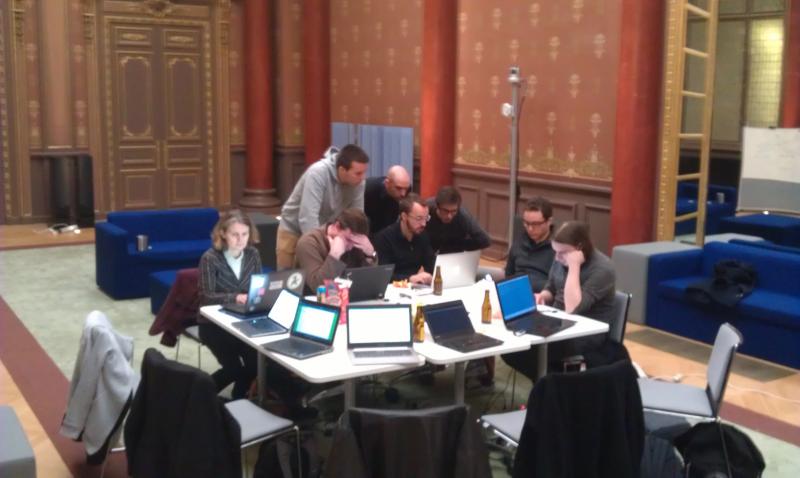
Encore une fois, ce MutterWare était un bon mélange entre utilisateurs (très) expérimentés, et non-utilisateurs de Mutt curieux de voir comment fonctionne le machin et prêts à ouvrir leur terminal pour commencer à configurer la bête !
Quelques informations ont été ajoutées au wiki : https://wiki.fsfe.org/groups/Paris/Mutterware.
Pour ma part, j’insisterai sur cette très bonne page qui permet de démarrer sur Mutt. C’est en anglais mais c’est bien écrit. Cette page a cependant deux défauts à mon avis : elle se concentre sur l’usage à partir d’un serveur mail chez Google (or Gmail a des tas de particularités pas très orthodoxes) et elle se limite à un seul compte. Or je ne sais pas pour vous mais moi, j’ai deux comptes : l’un est plus, « personnel ».
Enfin, la cerise sur le gâteau, c’est Emmanuel qui l’a apportée en me montrant l’outil t-prot, qui permet de nous débarrasser de toutes ces petites choses qui peuvent être désagréables dans le mail : les gens qui font des citations trop longues, les gens qui font du top-posting ou encore les gens ont des signatures de 3 kilomètres. T-prot a aussi des fonctions particulières pour Mutt, comme par exemple l’argument --pgp-move qui déplace les informations relatives aux signatures openPGP d’un email vers le bas, et non vers le haut comme c’est le cas par défaut, ce qui permet d’avoir accès plus directement au contenu du mail, sans avoir à scroller ! Plus d’infos sur la config T-prote d’Emmanuel sur le wiki.
Du coup, j’ai touché pas mal à ma config (dispo sur https://github.com/hugoroy/.mutt). Tout est désormais plus sobre depuis que j’ai modifié les barres de statuts, retiré la barre d’aide, et remplacé quelques codes couleurs. Lire ses mails sur Mutt est encore plus plaisant qu’avant ☺
À bientôt pour la 3e édition ! N’hésitez pas à vous inscrire sur la liste fsfe Paris https://lists.fsfe.org/mailman/listinfo/paris ou à nous rejoindre sur irc #fellows-paris.